← Back to Blog
Legal AI
Private AI for Law Firms: Secure Document Intelligence That Never Leaves Your Control
Zedly AI Editorial Team
December 3, 2025
10 min read
Law firms are under mounting pressure to adopt AI. Clients expect faster turnaround, leaner bills, and smarter document review. But the same firms that need AI the most handle the most sensitive information on earth: privileged communications, sealed court filings, M&A deal terms, trade secrets under NDA, and litigation strategies that could move markets. Every document that touches a public AI service becomes a liability, a potential privilege waiver, a discoverable record on a third party's server, and a training data point for a model that serves your opponents too.
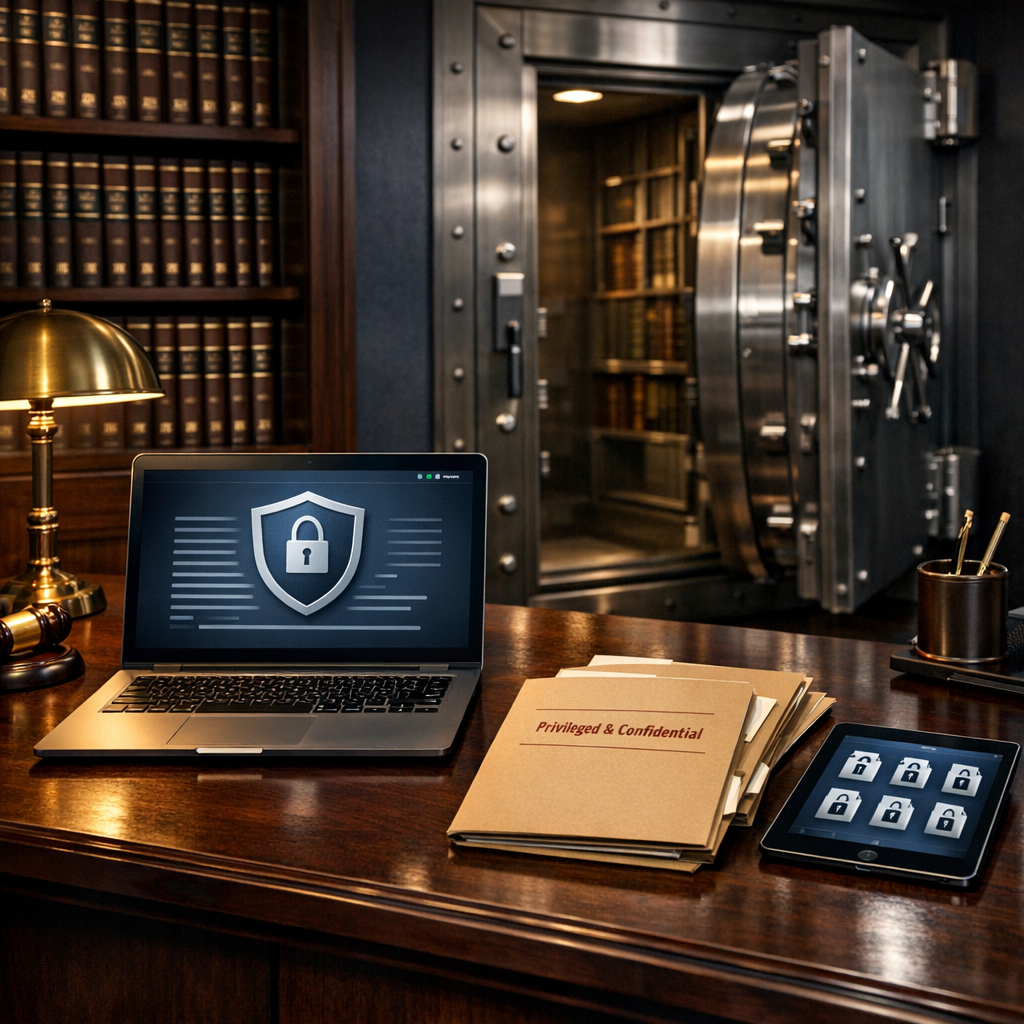
Private AI resolves this tension. It delivers the speed and intelligence of modern document AI while keeping every byte of client data inside your security perimeter. No prompts sent to external APIs. No documents used for model training. No shared infrastructure between firms. This is how the Vault & Desk model works, and why leading firms are adopting it.
Attorney-Client Privilege Meets Artificial Intelligence
Attorney-client privilege is the foundation of legal practice. It only works if clients trust that their communications remain confidential. When a firm sends privileged documents through a public AI service, that trust is at risk in ways that are difficult to undo.
The risks are specific and well-documented:
- Training data exposure. Many commercial AI providers reserve the right to use input data for model improvement. A privileged memo processed through such a service could influence model outputs visible to other users, including opposing counsel.
- Third-party subpoena risk. Data stored on a third party's servers can be subpoenaed. If your client's privileged documents reside on an AI vendor's cloud, they are potentially discoverable through the vendor, creating a vector for privilege challenges that did not exist before.
- Inadvertent waiver. Sharing privileged material with a third party without adequate confidentiality protections may constitute waiver. While some jurisdictions have safe harbors, the analysis is fact-specific and the risk is real.
- Regulatory scrutiny. ABA Formal Opinion 477R requires lawyers to make "reasonable efforts to prevent the inadvertent or unauthorized disclosure of, or unauthorized access to" client information when using technology. State bars in California, Florida, New York, and others have issued supplemental guidance emphasizing these obligations in the AI context specifically.
The practical upshot: a firm that routes privileged documents through a public AI tool is creating risk that no engagement letter disclaims away. Private AI eliminates these vectors entirely by keeping all processing inside the firm's security boundary.
The Vault & Desk Model
Zedly separates document storage from document analysis with a purpose-built two-layer architecture. This separation is not cosmetic. It reflects how law firms actually work: most documents sit in long-term storage, and only a small subset is actively under review at any given time.
The Vault
The Vault is your firm's encrypted document repository. Every file uploaded to Zedly is stored here with AES-256 encryption at rest, access controls tied to user roles and workspace membership, and comprehensive audit logging. The Vault holds contracts, briefs, discovery productions, correspondence, due diligence materials, and anything else the firm needs to retain.
Documents in the Vault are not searchable or analyzable by default. They are stored securely and indexed for retrieval, but no AI processing occurs on Vault contents until you explicitly activate them. This means the firm's entire document corpus can live in Zedly without incurring compute costs or creating unnecessary exposure.
The Active Desk
The Desk is your working surface. When you need to analyze documents for a specific matter, you select them from the Vault and add them to the Active Desk. Only documents on the Desk are embedded, indexed, and searchable by the AI engine.
This matters for several reasons:
- Matter-based scoping. The Desk ensures that queries only search documents relevant to the current matter. An attorney working on a patent dispute does not accidentally surface results from an unrelated M&A data room.
- Privilege review support. By controlling which documents are active, teams can ensure that privileged materials are only searchable when appropriate and by authorized users.
- Conflict walls. Separate workspaces with independent Desks support ethical screens. Laterals and conflict-checked teams work in isolation without access to materials from adverse matters.
- Cost predictability. AI processing costs accrue only on active documents. The firm pays for what it uses, not what it stores.
When a matter concludes or a review phase ends, clear the Desk. Embeddings and working indexes are purged. The original documents remain safely in the Vault with their audit trail intact.
Context Windows Built for Discovery
Legal matters do not fit in 8K tokens. A single deposition transcript can run 500 pages. A document production for a mid-size commercial dispute routinely contains tens of thousands of files. Regulatory investigations can involve millions of pages.
Zedly's chunking and retrieval system handles documents of any size. During ingestion, documents are parsed, OCR-processed if scanned, and split into semantically coherent chunks that preserve context across paragraph and section boundaries. Each chunk is embedded and indexed for retrieval.
The retrieval engine uses hybrid search combining vector similarity and keyword matching to find the most relevant passages across your entire active document set. Ask about a specific clause buried in exhibit 47 of a 200-document production. The system finds it, cites the exact page, and surfaces related language from other documents in the same query.
Every result links back to the source document and page, so attorneys can verify context with one click. No hallucinated citations. No unverifiable claims. Just the passage, the page number, and a direct link to the original.
Legal-Tuned Embeddings
General-purpose AI models stumble on legal terminology. "Motion to compel" and "motion to dismiss" look similar to standard embeddings but carry opposite meanings in practice. "Indemnification" and "hold harmless" are near-synonyms in contract drafting, but a generic model may not treat them that way.
Zedly automatically detects legal documents and routes them through Voyage-law-2, an embedding model trained specifically on case law, contracts, and regulatory filings. General business documents, financial records, and correspondence use Voyage-3 for broad coverage. Teams never configure embedding models or think about which pipeline processes their files.
The result is search quality that understands legal language the way lawyers do. For a deeper look at how legal-tuned embeddings and hybrid retrieval work together, including reciprocal rank fusion and practical search examples, see our technical breakdown of hybrid search for legal teams.
Privacy That Satisfies the Bar
Model Rules of Professional Conduct require competence in technology (Rule 1.1, Comment 8) and confidentiality in client communications (Rule 1.6). Multiple state bars have issued formal opinions on AI use, and the consensus is clear: lawyers must understand how AI tools handle client data and ensure that confidentiality is maintained.
Zedly's Private AI is built to satisfy these requirements structurally, not just through policy promises:
- No third-party model training. Documents, prompts, and responses are never used for model training, fine-tuning, or improvement. This is a contractual commitment.
- Namespace isolation. Embeddings and indexes for each organization exist in an isolated namespace. There is no shared vector space, no cross-tenant retrieval, and no possibility of one firm's data influencing another firm's results.
- No external API calls with client data. Inference runs without routing prompts through third-party model providers. The data path stays inside the security perimeter.
- Audit logging. Every document access, query, retrieval, and response is logged with user identity, timestamp, and action taken. Logs are exportable for compliance review and available to firm administrators on demand.
For firms requiring full network isolation, such as those handling ITAR-controlled technical data, classified discovery materials, or matters with court-ordered security protocols, air-gapped on-premise deployment eliminates all external connectivity while preserving full document AI functionality.
Organization-Level Controls
Managing partners need visibility into how AI tools are used across the firm. Zedly provides organization-wide controls that make adoption safe at scale:
- Storage pools. Firm-wide storage allocation with visibility by practice group, matter, or user.
- Per-seat Desk budgets. Configurable capacity limits on the Active Desk prevent any single user from consuming disproportionate compute resources.
- Ingestion quotas. Large uploads require approval before processing. A first-year associate cannot accidentally ingest a 50 GB document dump overnight.
- Usage dashboards. Real-time visibility into storage, query volume, ingestion activity, and cost projections across the organization.
For the full breakdown of guardrails including rate limiting, budget enforcement, and how these controls work in practice across large legal teams, see Hybrid Search + Guardrails for Legal Teams.
Encryption and Data Isolation
Privacy architecture is only as strong as its lowest layer. Zedly's data isolation model is designed for regulated industries where a single exposure event can trigger malpractice claims, bar complaints, or regulatory sanctions:
- Encryption at rest: All documents in the Vault are encrypted with AES-256. Encryption keys are managed per-organization.
- Encryption in transit: All data between the client and Zedly's infrastructure travels over TLS 1.2+ with no exceptions.
- Workspace isolation: Each workspace operates as an independent environment. Documents, embeddings, indexes, and query histories in one workspace are completely invisible to users in another. This supports ethical screens, conflict walls, and multi-client isolation within a single firm.
- Object Lock for audit trails: Critical metadata and audit logs are stored with Object Lock (WORM) protection on Backblaze B2, making them immutable. Once written, they cannot be altered or deleted, even by administrators. This creates a tamper-evident record for compliance review and potential litigation holds.
- No cross-workspace data access. There is no administrative backdoor, no "super admin" view across workspaces, and no mechanism for one workspace's data to leak into another's search results.
From Brief Research to Due Diligence
Private AI is not a single-purpose tool. The same secure infrastructure handles every document intelligence task a firm encounters:
- Precedent research. Build a searchable library of the firm's own briefs, memos, and opinions. Search for relevant authority or persuasive language across years of work product without exposing any of it to external services.
- PI medical record review. Upload thousands of pages of medical records and build chronologies, flag treatment gaps, extract billing codes, and prep deposition questions in a single session. For a complete prompt library and workflow guide, see Private AI for Personal Injury Lawyers.
- Contract review. Upload a portfolio of agreements and search for specific clause types, risk factors, or deviations from the firm's standard terms. Legal-tuned embeddings understand that "cap on liability" and "limitation of damages" describe the same concept.
- M&A due diligence. Load a data room into the Active Desk and surface red flags, unusual terms, and missing disclosures in hours rather than weeks. When the deal closes or falls through, clear the Desk and all working data is purged.
- Discovery and document review. Search thousands of documents for specific terms, concepts, or communication patterns. Hybrid search ensures that exact identifiers (Bates numbers, exhibit references, party names) surface alongside semantically relevant passages.
- Regulatory compliance. Search internal policies against regulatory requirements. The system finds both exact regulation numbers and broader discussions about compliance intent, even when the language differs.
Every use case benefits from the same privacy guarantees: no data leakage, full audit trails, and matter-scoped analysis that keeps client information compartmentalized.
Start With One Matter
Most firms pilot Zedly on a single case. Pick a matter with a manageable document set, perhaps a contract review or a regulatory inquiry. Upload the relevant files to the Vault, add them to the Active Desk, and start asking questions.
Within days, the value becomes concrete: research that took hours completes in minutes, relevant clauses surface from documents the team had not yet reviewed manually, and every result includes a verifiable citation to the source page. More importantly, the firm's IT and compliance teams can verify that no data left the security perimeter, no documents were used for training, and the full audit trail is available for review.
Your clients trust you with their most sensitive information. Private AI is how you honor that trust while still moving at the speed modern legal practice demands.
Frequently Asked Questions
Is Zedly's AI private enough for attorney-client privileged documents?
Yes. Zedly's architecture is designed specifically for privileged materials. Documents are encrypted at rest with AES-256 and in transit with TLS 1.2+. Prompts and responses never leave your security perimeter, and no data is sent to third-party model providers for training. Each organization's data is isolated in its own namespace with no cross-tenant access. The Vault and Desk model ensures that only documents you explicitly activate are searchable, and audit logs track every access event for privilege review.
Does Zedly train its models on my firm's data?
No. Zedly never uses customer documents, prompts, responses, or any derivative data (including embeddings) for model training, fine-tuning, or improvement of any kind. This is a contractual commitment, not just a policy. Your data exists solely to serve your firm's queries and is never shared across workspaces or used to improve services for other customers.
What bar association guidance applies to law firms using AI?
ABA Formal Opinion 477R requires lawyers to make reasonable efforts to prevent inadvertent or unauthorized disclosure of client information when using technology. Multiple state bars have issued guidance requiring disclosure of AI use in certain contexts and emphasizing that lawyers remain responsible for AI-assisted work product. The key obligations are: ensure confidentiality of client data, understand how the AI tool handles information, verify AI outputs before relying on them, and maintain competence in the technology you use. Zedly's private architecture, zero-training policy, and audit logging are designed to satisfy these requirements.
Can different practice groups be isolated from each other?
Yes. Zedly supports workspace-level isolation within an organization. Each practice group or matter team can operate in a separate workspace with its own document Vault, Active Desk, and access controls. Documents in one workspace are invisible to users in another. This supports conflict-of-interest walls (ethical screens) and ensures that laterals, contract attorneys, or secondees only access the materials relevant to their assigned matters.
What happens to documents after I clear the Active Desk?
When you clear the Active Desk, the document embeddings and working indexes are purged from the analysis environment. The original files remain in the Vault unless you explicitly delete them. No residual data from Desk processing persists in the search index, cache, or any intermediate storage. Audit logs recording that the documents were processed are retained for compliance purposes, but the substantive content is gone from the active environment.
Looking for enterprise-grade legal AI?
Explore the full picture: contract review, clause extraction, due diligence workflows, and deployment options designed for regulated firms. Explore Legal AI →
Ready to Secure Your Practice?
See how Zedly's Vault & Desk model, legal-tuned embeddings, and organization controls give your firm AI superpowers without the risk.
Schedule a Private Demo
Comparing enterprise AI platforms?
See a detailed breakdown of deployment, compliance, pricing, and document features.
Ready to get started?
Private-by-design document analysis with strict retention controls.