How to Cite a Clause in a Contract (Plus: How to Make AI Cite Clauses Correctly)
Zedly AI Editorial TeamFebruary 24, 20269 min read
Knowing how to cite a clause in a contract is one of those skills that sounds simple until you actually need to do it precisely. Whether you are writing a legal memo, flagging a risk in a vendor contract review, or referencing specific language in a negotiation email, a clear citation saves everyone time and prevents misunderstandings.
The short answer: cite the document name, section or article number, and clause title (if one exists). Here are two examples:
PDF without section numbers: "Vendor NDA dated January 15, 2026, page 4, third paragraph (Non-Solicitation)"
That covers the basics. But contracts come in many formats: some have clean numbered sections, others bury critical language in exhibits, and PDF page numbers do not always match printed page numbers. Below, we cover every common format you will encounter, then show how to get AI contract review tools to produce reliable clause-level citations.
Citing Clauses in Numbered Contracts
Most commercial contracts (MSAs, NDAs, SaaS agreements, employment contracts) use hierarchical numbering: articles, sections, and subsections. This is the easiest case.
The Standard Pattern
Use the hierarchy as it appears in the document:
Article level: "Article VII (Indemnification)"
Section level: "Section 7.2 (Indemnification by Vendor)"
Subsection level: "Section 7.2(a) (Scope of Indemnified Claims)"
Always include the descriptive title in parentheses when the contract provides one. Titles prevent confusion when someone reorganizes sections during negotiation, since the numbers may shift but the titles stay meaningful.
When Numbers Use Different Schemes
Some contracts use Roman numerals at the article level (Article III) and Arabic numerals for sections (Section 3.1). Others use letters for subsections (Section 3.1(b)). Cite the numbering exactly as it appears in the document. Do not convert between schemes, as that introduces ambiguity about which version of the contract you are referencing.
Definitions Sections
When citing a defined term, reference the definitions section where the term is established: "as defined in Section 1.14 ('Confidential Information')." This matters because defined terms carry specific contractual meaning that may differ from their ordinary English usage.
Citing Clauses in PDF Contracts
PDFs add a layer of complexity because the document may have two different page numbering systems: the printed page numbers in the document footer and the PDF reader's page count (which includes cover pages, signature pages, and table of contents).
Section Number + PDF Page
The most reliable approach combines both:
"Section 14.2 (Limitation of Liability), page 23 of the executed PDF"
"Section 5(c) (Data Retention), PDF page 11"
This gives the reader two ways to find the clause: search for the section number, or scroll to the page.
When the PDF Lacks Section Numbers
Older contracts, scanned documents, or informal agreements often lack numbered sections. In that case, cite by page and position:
"Page 7, paragraph 3 (beginning 'The Receiving Party shall...')"
"Pages 12-13, the provision titled 'Intellectual Property'"
Including the first few words of the clause provides a text anchor that works even if pagination changes between PDF viewers.
Scanned PDFs vs. Text-Based PDFs
Text-based PDFs (where you can select and copy text) support Ctrl+F search, making section-number citations easy to verify. Scanned PDFs (images of printed pages) do not support text search without OCR processing. If you are working with scanned contracts, include the page number and a text snippet so the recipient can manually locate the clause.
Citing Exhibits, Schedules, and Amendments
Commercial agreements rarely exist as a single document. They come with exhibits, schedules, appendices, side letters, and amendments, each of which can contain clauses worth citing.
Exhibits and Schedules
Reference the attachment by its label, then the clause within it:
"Exhibit A (Statement of Work), Section 3 (Deliverables)"
Many contracts include an integration clause stating that all exhibits are incorporated by reference. When citing an exhibit clause in a legal memo, note whether the exhibit is incorporated to establish that it carries contractual weight.
Amendments and Side Letters
When a contract has been amended, specify which version you are citing:
"First Amendment to MSA, dated March 1, 2026, Section 2 (Revised Payment Terms)"
"Side Letter re: Data Processing, paragraph 4 (Subprocessor Consent)"
If the amendment modifies a section from the original agreement, reference both: "Section 9.1 of the MSA (as amended by Section 2 of the First Amendment)." This is particularly important when there are conflicts between the original and amended language.
Master Agreement + Order Form Structures
SaaS and enterprise software deals often use a master agreement that sets general terms and order forms that specify pricing, quantities, and product-specific provisions. Cite the specific document: "Order Form #3, dated June 15, 2026, Section 4 (Support SLA)" rather than referencing the master agreement when the clause lives in an order form.
How to Cite Clauses in AI Contract Review
AI contract review tools accelerate clause extraction, but they introduce a new question: how do you verify that the AI found the right clause and cited it correctly? The answer depends on the tool's citation format and your verification workflow.
What Good AI Citations Look Like
A well-designed AI contract review tool provides structured citations alongside every extracted clause. These typically include:
Section reference: The section number and title from the contract itself (e.g., "Section 8 Retention and Deletion")
Document reference: The specific file being cited, especially when multiple documents are loaded
Location marker: A chunk ID, page number, or line range that maps to the exact position in the document
This level of detail lets you verify each citation against the source, rather than trusting the AI's summary at face value. For more on what contract review tools should catch, see our practical checklist for contract review AI.
The "Refuse If No Cite" Pattern
When prompting an AI tool to review a contract, explicitly require citations in the output. A prompt like "Extract the termination provisions and cite the section number for each" produces more verifiable results than "Summarize the termination terms." If the tool cannot point to a specific section, that answer should be treated as unverified.
Some practical prompt patterns:
"What are the data retention obligations? Cite the specific section for each."
"List all indemnification provisions with section numbers and page references."
"Does this contract contain a non-compete? If yes, cite the exact clause."
If the AI returns an answer without a citation, do not use it in a memo, email, or negotiation point. Require the cite, or find the clause manually.
Verification Checklist for AI-Cited Clauses
After the AI extracts clauses with citations, verify before relying on the output:
Does the section number exist? Open the original document and confirm the cited section is real.
Does the quoted language match? Compare the AI's extracted text against the actual contract language, word for word.
Is the clause complete? AI sometimes truncates clauses or misses qualifying language ("except as provided in Section 12.3").
Is the citation from the right document? When multiple files are loaded, verify the AI cited the correct contract, not a similar clause from a different agreement.
Does the context change the meaning? A clause may read differently when you see the surrounding provisions, definitions, or carve-outs.
This checklist takes two minutes per clause. It is far faster than reading the entire contract, but it preserves the human judgment that AI cannot replace. For teams building guardrails around legal AI usage, this verification step is the most important control.
What Clause-Level Citations Look Like in Practice
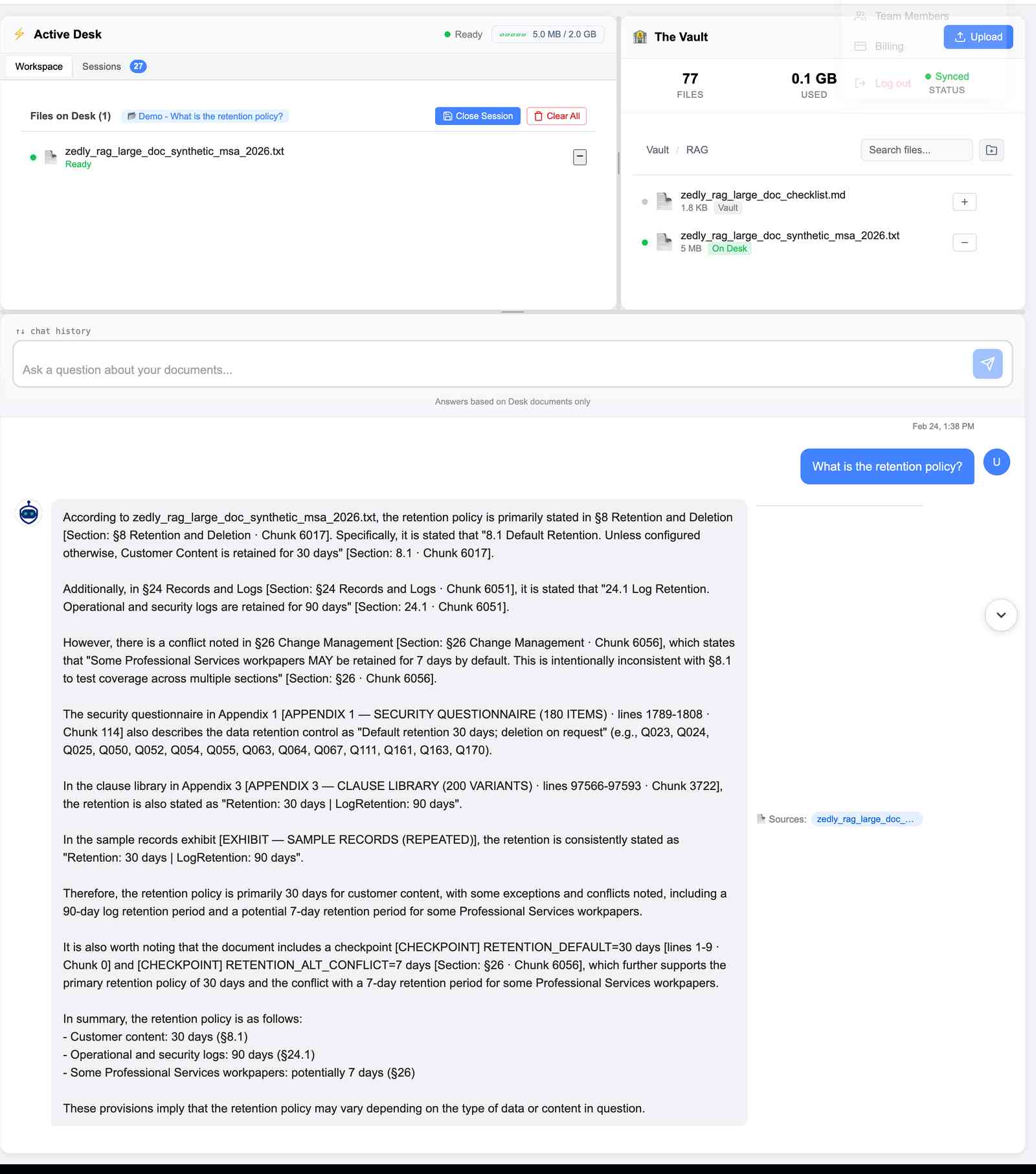
To make this concrete, here is a real example of an AI tool answering a contract question with full clause-level citations. The question, "What is the retention policy?", is asked against a large Master Services Agreement with appendices and a clause library.
Click to zoom
Zedly AI answering "What is the retention policy?" with citations to specific sections, subsections, appendices, and a clause library from a large MSA. Click to zoom and scroll.
Notice the citation format: each statement references a specific section (e.g., "Section: 8 Retention and Deletion"), subsection ("Section: 8.1"), and even appendix items ("APPENDIX 1, SECURITY QUESTIONNAIRE, Q023"). The response also flags a conflict between sections, noting that Section 26 (Change Management) states a 7-day retention for some workpapers while Section 8.1 states 30 days. This kind of cross-reference across contract sections is exactly what clause-level citations enable.
Common Mistakes When Citing Contract Clauses
Even experienced professionals make citation errors that create confusion or, worse, legal risk. Here are the most common ones:
Citing the wrong version. Amendments, restated agreements, and order form updates create multiple versions of the "same" contract. Always specify which version: "Section 5 of the MSA" is ambiguous if there have been three amendments. "Section 5 of the MSA (as amended through the Third Amendment, dated October 1, 2025)" is not.
Omitting the document name. In a deal with an MSA, three order forms, an SLA, and a DPA, citing "Section 3.2" without specifying which document is meaningless. Always include the document name or label.
Confusing PDF page numbers with printed page numbers. A 50-page contract with a 2-page cover sheet means PDF page 12 is printed page 10. Specify which numbering system you are using.
Paraphrasing instead of citing. "The contract says we can terminate for convenience" is a paraphrase. "Section 12.1 (Termination for Convenience) provides that either party may terminate upon 90 days' written notice" is a citation. The latter is verifiable; the former requires the reader to hunt for the source.
Ignoring defined terms. Citing "confidential information" without referencing the definition section risks confusion if the contract defines "Confidential Information" with specific inclusions or exclusions that differ from the ordinary meaning.
Frequently Asked Questions
How do you cite a clause in an AI contract review tool?
In an AI contract review tool, you cite a clause by referencing the section number, subsection, and document name that the tool surfaces alongside its answer. Good tools include structured citations like [Section: 8 Retention and Deletion, Chunk 6017] or [Section: 24.1, Chunk 6051]. Always verify the cited passage against the original document before relying on it in any legal or business context.
What if the contract doesn't have section numbers?
When a contract lacks section numbers, cite by page number, paragraph position, or descriptive location. For example: "the third paragraph on page 7 of the Master Services Agreement dated January 15, 2026" or "the confidentiality provision beginning on page 12." You can also cite by exhibit or schedule label if the clause appears in an attachment rather than the main body.
How do you cite clauses in a PDF contract?
For PDF contracts, cite using the section or article number if the document has them, plus the PDF page number for quick navigation. Example: "Section 14.2 (Limitation of Liability), page 23 of the executed PDF." If using an AI tool, the tool should provide chunk or page references that map back to the PDF. Always confirm the page number matches the printed page, as PDF page numbers and printed page numbers sometimes differ.
How do you cite a clause from an exhibit or amendment?
Reference the exhibit or amendment by its label, then the clause within it. For example: "Exhibit B (Service Level Agreement), Section 3.2 (Uptime Commitment)" or "First Amendment to MSA, dated March 1, 2026, Section 2 (Revised Payment Terms)." Always specify which version of the agreement you are referencing, especially when multiple amendments exist.
What is the best format for citing contract clauses in a memo or email?
Use a consistent format that includes the document name, clause identifier, and a brief label. A practical pattern: [Document Name], [Section/Article Number] ([Clause Title]). For example: "MSA, Section 9.1 (Indemnification)" or "NDA dated Jan 5 2026, Clause 4 (Non-Solicitation)." This format is scannable, unambiguous, and works in both formal memos and quick emails.
Try Clause-Level Contract Extraction with Zedly AI
Upload a contract and ask a question. Every answer cites the specific section, subsection, and document location so you can verify the source language. Works across MSAs, NDAs, order forms, exhibits, and amendments.