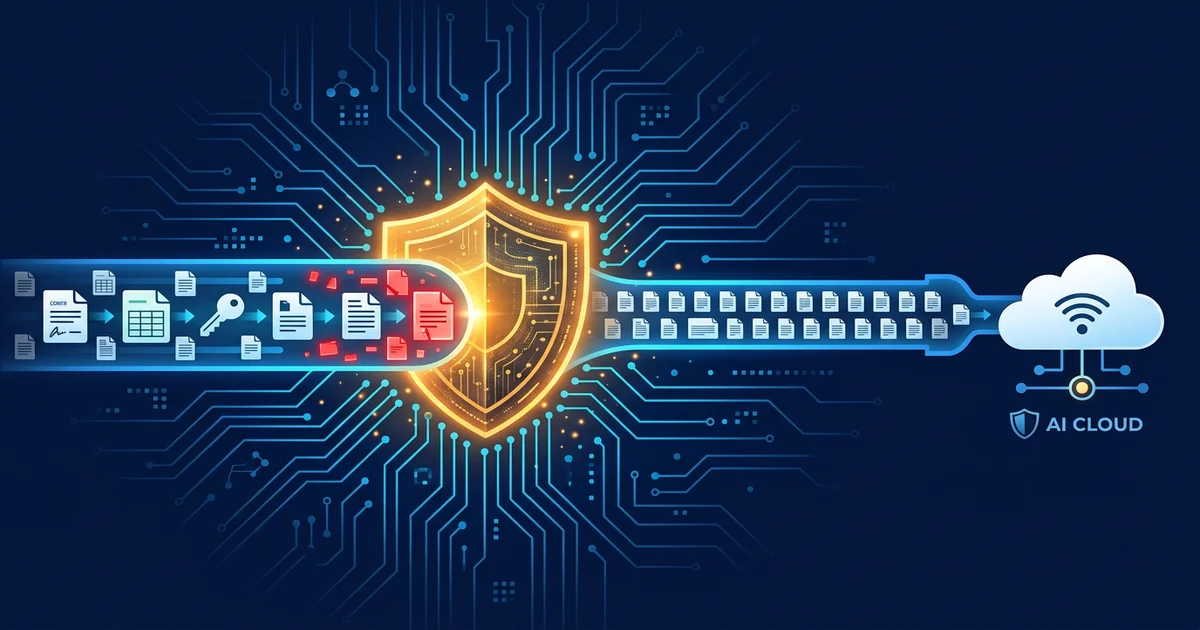
OpenClaw DLP Data Loss Prevention: On-Device Protection for Agentic AI
Zedly AI Editorial TeamMarch 31, 202612 min read
Agentic AI changes the data loss prevention problem. Traditional DLP tools monitor files and network traffic, but agents operate differently: they read documents, execute shell commands, browse the web, query APIs, and pass every result to a model provider as context for the next decision. Each tool call is a potential leak vector, and the data flow is driven by the model, not the user. Preventing data loss in this environment requires enforcement inside the execution pipeline, not around it.
This article covers why traditional DLP architectures fall short for agentic workflows, the three architectural approaches available today, and how on-device enforcement with Zedly Shield provides data loss prevention for OpenClaw enterprise deployments without routing sensitive data through third-party scanning infrastructure.
Why Traditional DLP Fails for Agentic AI
DLP solutions were designed for a world where humans move data: copying files to USB drives, emailing attachments, uploading documents to cloud storage. The enforcement model assumes predictable data paths and human-initiated transfers. Agentic AI breaks all three assumptions.
An OpenClaw agent running a contract review workflow might: read 15 PDF files from a shared drive, extract party names and dollar amounts, write intermediate results to local files, query a database for related agreements, browse a government site for regulatory context, and pass the entire accumulated context to an external model provider across multiple turns. That sequence happens autonomously, in seconds, with no human approving each step.
The data paths are determined by the model's reasoning, not by a user's click. And the leak does not look like a file copy or an email attachment; it looks like an API call to api.openai.com containing 50,000 tokens of context that happen to include contract terms, internal identifiers, and employee names.
Three specific gaps make traditional DLP ineffective for this pattern:
No tool call visibility: endpoint DLP sees file reads and network connections at the OS level. It cannot distinguish "agent read a confidential contract and is about to send its contents to an external LLM" from "user opened a PDF in a viewer." The semantic context, what the data is being used for and where it is going next, is invisible.
No content inspection at the model boundary: network DLP inspects HTTP payloads, but model API calls use HTTPS with payloads that encode the full conversation history, system prompt, and tool results as structured JSON. Generic payload scanning misses the structure and cannot apply policy to specific fields.
No policy at the execution layer: when an agent decides to run cat /legal/contracts/merger-agreement.pdf, the command executes with the agent's OS permissions. By the time endpoint DLP detects the file access, the content is already in the agent's context and queued for the next model call. Prevention requires blocking before execution, not alerting after.
The OWASP Top 10 for LLM Applications identifies excessive agency, insecure output handling, and sensitive information disclosure as core risks for systems where LLMs invoke tools. Data loss prevention for agentic AI is the operational response to those risks.
Three Architectural Approaches to Agentic DLP
The market is converging on three distinct architectures for preventing data loss in agent workflows. Each makes different trade-offs on coverage, trust boundaries, and deployment complexity.
Approach 1: Cloud Proxy Gateway
A cloud-hosted service sits between the agent and the model provider. All outbound API calls route through the proxy, where payloads are inspected for PII, secrets, and classified content before forwarding to the model.
Strengths: catches outbound prompts before they reach the provider; central management across multiple agents and locations; can apply classification policies from enterprise DLP platforms.
Weaknesses: your sensitive data is sent to the proxy vendor's infrastructure for scanning. For teams handling regulated data (healthcare records, financial documents, legal privileged material), this introduces a third-party data processor into the flow. The proxy also adds network latency to every model call. If the agent makes a direct HTTP connection that bypasses the proxy (split tunneling, VPN exceptions, local model calls), the protection is gone.
Approach 2: Endpoint DLP Agent
An OS-level agent monitors file access, network connections, and clipboard activity on the endpoint where the agent runs. Existing endpoint DLP and CASB tools can be configured to watch for data movements from agent processes.
Strengths: broad coverage across file, network, and clipboard channels; leverages existing enterprise DLP investment; can block at the OS level before data leaves the machine.
Weaknesses: no semantic understanding of agent workflows. The endpoint agent sees file reads and network connections, but it cannot distinguish a benign file open from an agent about to send document contents to an external model. It cannot inspect the structured JSON payloads of model API calls. And it cannot apply different policies based on tool type, session context, or content sensitivity at the application level.
Approach 3: On-Device Execution Boundary
The enforcement layer is embedded in the agent's execution pipeline. Instead of intercepting traffic between the agent and the model, the boundary is the execution layer: the process that runs shell commands, reads files, and returns results to the agent. Content is scanned locally before the agent framework even receives it.
Strengths: the agent cannot bypass the boundary because it depends on it to execute. All scanning happens on-device; no data is sent to a third party for inspection. The boundary has full semantic context: it knows which tool was called, what arguments were used, what path was accessed, and what content is about to enter the model context. Policy decisions happen before execution, not after detection.
Weaknesses: requires integration with the specific agent framework. Does not inspect outbound network traffic that the agent generates directly (e.g., HTTP tool calling an external API). Coverage is bounded by the hooks and execution paths the agent framework exposes.
PII tokenized, API keys removed, denied content stripped
Audit Log
SHA-256 hash chain, JSONL
Dashboard
Fleet visibility
Dual-layer enforcement: the plugin intercepts at the gateway level, the daemon intercepts at the execution level. Both scan independently.
Zedly Shield uses Approach 3. The Shield daemon (shieldd) is a compiled Rust binary that acts as the mandatory execution boundary for OpenClaw tool calls. The Shield plugin hooks into the OpenClaw gateway to enforce policy on tool results before the model sees them. Together, they create a dual-layer enforcement architecture where sensitive data is caught at two independent checkpoints.
What Shield Protects Today
Shield ships with nine active protection layers, all enforced on-device. The base protections are enabled by default with zero configuration required.
Every tool call, policy decision, and redaction event logged with SHA-256 hash chaining
On
Plugin + dashboard
The daemon is a compiled Rust binary (single static executable, no runtime dependencies). It runs as the execution layer for shell commands: when the agent calls exec, the daemon evaluates the command against policy, executes it in a sandboxed context, scans the output for sensitive data, and returns the sanitized result. The agent framework never sees the raw output.
The plugin runs inside the OpenClaw gateway process. It hooks into before_tool_call (to block dangerous operations before they execute) and tool_result_before_model (to redact sensitive content before the model sees it). Both layers run independently: if one misses something, the other catches it.
Enterprise security teams evaluating agentic AI consistently raise the same set of risks. Here is how each maps to Shield's current protection and where gaps remain.
Shadow AI Usage
Employees running agents without IT approval is a growing concern: agents installed outside managed deployment bypass traditional endpoint controls. Shield addresses this at the execution layer. Once the daemon is installed on a machine, it enforces policy on every tool call regardless of how the agent was set up, who configured it, or whether IT sanctioned the installation. The enforcement is structural, not administrative.
Plaintext Secrets in Config Files
Agent frameworks store API keys, provider credentials, and tokens in local config files (JSON, TOML, plist, shell profiles). These files are readable by the agent and by any process on the machine. Shield addresses this on two fronts: the daemon's real-time detection automatically redacts 12 API key formats when they appear in tool output, and the shieldd audit CLI command scans the local machine for plaintext secrets in common config locations and reports findings with remediation steps.
Untrusted Extensions and Skills
Community-maintained agent extensions can contain code that exfiltrates data through tool calls. Shield does not currently scan extensions or skill files for malicious code. This is a known gap. Shield's content deny lists and PII redaction catch data in transit regardless of which extension triggered the tool call, but proactive extension scanning is a roadmap item.
Agent-to-Agent Data Flow
When one agent spawns a sub-agent or sends data to another agent session, the inter-agent communication can carry sensitive content that bypasses per-session policy. Shield currently logs agent lifecycle events (start, end) and tool calls within each session, but it does not yet correlate data flow across agent boundaries. Cross-agent data flow monitoring is on the roadmap.
Sensitive Content in Outbound Prompts
Even after tool-result redaction, the accumulated conversation history can contain sensitive content that reaches the model provider. Shield's content deny lists and PII redaction catch known patterns in tool results before they enter the context. The planned outbound network proxy (a local HTTPS proxy that inspects model API payloads before they leave the machine) will close this gap for prompts assembled from multiple turns of context accumulation. For teams that cannot wait, routing sensitive workflows to a local model via Ollama eliminates the outbound data path entirely.
What's Coming: The Shield Roadmap
Four capabilities in active development extend Shield's protection from reactive pattern matching to proactive content-aware enforcement.
Capability
What it does
Why it matters for DLP
Entity tokenization
Replace sensitive named entities (party names, dollar amounts, dates) with surrogate tokens before the model sees them; rehydrate real values in the response
The model can reason about document structure and relationships without seeing actual sensitive data. The token map stays on-device.
Content-based model routing
Automatically route queries involving sensitive content to a local model instead of an external provider
The employee gets their answer; the data never leaves the building. No manual intervention required.
Document fingerprinting
Register hashes of known sensitive documents; detect when partial or paraphrased content from those documents appears in agent output
Catches content from registered documents even when the text is restructured or partially quoted.
Outbound network proxy
Local HTTPS proxy that intercepts model API calls and scans the full prompt payload before it leaves the machine
The last-mile DLP layer: catches anything the tool-result hooks missed after context accumulation across turns.
The full technical details, configuration options, and test parameters for each phase are documented in the Shield repository content protection roadmap.
Deploying DLP for OpenClaw Today
Shield can be deployed in under ten minutes. The base protection stack (PII redaction, API key detection, shell blocking, prompt injection, audit logging) requires no configuration beyond installation.
Step 3: Install the daemon (optional, recommended)
The daemon adds a mandatory execution boundary for shell commands. On macOS:
curl -sSf https://shield.zedly.ai/install.sh | sh
shieldd start
Step 4: Add organization-specific protections
Create ~/.openclaw/zedly-shield/shieldd.toml with content deny lists, path sensitivity rules, and custom redaction patterns tailored to your organization:
Scan your machine for plaintext secrets in config files:
shieldd audit
The audit command checks LaunchAgent plists, shell profiles, .env files, SSH key permissions, and other common secret storage locations. Fix any HIGH severity findings before deploying agents in production.
How This Fits the Enterprise Security Stack
Shield is not a replacement for endpoint DLP, network DLP, or CASB tools. It is a purpose-built layer for the execution boundary that those tools cannot see into. In a mature enterprise security architecture, Shield sits between the agent framework and the existing perimeter controls:
Endpoint DLP monitors file access and network connections at the OS level. Shield adds semantic context: which tool triggered the access, what content was in the result, and whether the content was redacted before reaching the model.
Network DLP / CASB inspects outbound traffic for data classification labels. Shield's tamper-evident audit log provides the tool-call-level evidence trail that network-level inspection cannot reconstruct.
SIEM / SOC collects security events across the enterprise. Shield's dashboard forwarding sends structured events (JSON, hash-chained) that map directly to agent actions, policy decisions, and redaction outcomes.
The combination is complementary: endpoint DLP catches data movements Shield cannot see (clipboard, external storage devices); Shield catches agent-specific data flows endpoint DLP cannot interpret (tool results entering model context, content deny matches, prompt injection attempts).
Start Protecting Agent Data in 60 Seconds
Zedly Shield installs as a single OpenClaw plugin. No code changes, no cloud scanning, no data leaves your machine.
Zero-config API key detection — 12 provider patterns active on install
OpenClaw does not include native DLP. However, the gateway's plugin system exposes hooks (before_tool_call, tool_result_before_model) that allow external plugins to inspect and modify every tool call and tool result. Zedly Shield uses these hooks to add PII redaction, API key detection, content deny lists, and policy-based blocking without changes to agent code. The enforcement runs locally on the same machine as the gateway.
Can traditional endpoint DLP protect OpenClaw agents?
Partially. Traditional endpoint DLP monitors file access and network traffic at the OS level, which catches some data movements. But it has no visibility into tool call semantics: it cannot distinguish an agent reading a confidential contract from a user opening a PDF, and it cannot inspect the structured content that flows between tool results and the model. Agentic DLP requires enforcement inside the agent execution pipeline, not alongside it.
What is the difference between a cloud DLP proxy and an on-device execution boundary?
A cloud DLP proxy sits between the agent and the model provider, intercepting network traffic. Your data is sent to the proxy vendor's servers for scanning before reaching the model. An on-device execution boundary runs on the same machine as the agent; the daemon is the process that executes tool calls, so all data is scanned locally without leaving the device. The on-device approach eliminates the need to trust a third party with your sensitive data during the scanning step.
Does Zedly Shield work in air-gapped environments?
Yes. Shield's enforcement (PII redaction, API key detection, shell blocking, content deny, audit logging) runs entirely on-device with no network dependencies. The optional dashboard forwarding requires outbound HTTPS, but the core protection stack operates offline. Combined with a local model provider like Ollama, the entire agent pipeline runs with zero internet connectivity.
What types of sensitive data does Shield detect?
Shield detects structured PII (email addresses, Social Security numbers, credit card numbers), API keys from 12 providers (OpenAI, Anthropic, Google, Groq, AWS, GitHub, Stripe, and others), private key headers (PEM and OPENSSH formats), and customer-defined content patterns (keywords, regex, internal identifiers). All detection runs locally using compiled regex patterns with sub-millisecond latency per tool call.